

When Food Recalls Make You Anxious: How to Stay Informed Without Feeling Consumed
Food recalls can feel scary.
One day it is lettuce. Then eggs. Then deli meat. Then pet food. Then a post online claims that a common ingredient is dangerous, and suddenly grocery shopping feels less like a regular errand and more like trying to survive a pop quiz you did not study for.
If recent food recalls, outbreak alerts, or online food safety claims have made you feel more anxious, you are not alone. Food is personal. We feed ourselves, our families, our children, our partners, our pets, and sometimes people we care for. When the news around food feels unpredictable, it can stir up fear quickly.
A certain amount of concern makes sense. Food safety matters. Paying attention to recalls can help prevent illness. But anxiety can take a reasonable concern and turn it into a constant loop of checking, researching, avoiding, and second-guessing.
The goal is not to ignore food safety. The goal is to stay informed in a way that protects both your body and your mental health.
Why Food Recall Anxiety Feels So Intense
Food-related anxiety can feel especially powerful because food is not optional. We have to eat. We have to shop. We have to prepare meals. We have to make decisions with imperfect information.
When recalls are in the news, your brain may start scanning for danger everywhere:
Is this brand safe?
Did I buy that product?
What if I missed a recall?
What if my child, partner, parent, or pet gets sick?
What if everything is contaminated?
What if the information online is true?
This can become exhausting, especially for people who already live with anxiety, trauma, obsessive worry, health anxiety, caregiving stress, chronic illness, pregnancy-related concerns, immune system concerns, or past experiences of food poisoning.
Anxiety often tries to create certainty. The problem is that food safety, like most areas of life, does not offer perfect certainty. So the anxious brain keeps searching.
And searching.
And searching.
Eventually, staying “informed” can start to feel like being trapped in a tiny newsroom inside your own head.
Recalls Are Concerning, But They Are Also Part of the Safety System
A food recall does not automatically mean the entire food supply is unsafe. It means a specific product may have a problem and is being removed from sale or flagged for consumers.
Food recalls may happen for several reasons, including possible contamination, undeclared allergens, mislabeling, foreign material, or links to a foodborne illness outbreak. Federal agencies such as the FDA, USDA Food Safety and Inspection Service, CDC, and FoodSafety.gov publish recall and outbreak information so consumers can take appropriate action.
That does not make recalls pleasant. No one wants to hear that something in their refrigerator might be unsafe.
But it may help to remember this: a recall is not only a sign that something went wrong. It is also a sign that monitoring, reporting, investigation, and removal systems are working.
The most useful question is usually not, “How do I eliminate all risk?” That is impossible.
A more helpful question is, “What reliable steps can I take right now?”
Verified Recall or Internet Claim? There Is a Difference
One reason food anxiety has increased for many people is that official recalls now exist alongside viral posts, wellness claims, influencer warnings, screenshots, rumors, and “I heard this is toxic” content.
Some online posts are accurate and helpful. Others are exaggerated, missing context, outdated, or completely unverified.
A verified recall usually includes specific information, such as:
Product name
Brand
Lot number or batch code
Best-by date
Location where the product was sold
Reason for the recall
What consumers should do next
A general online claim may sound urgent but lack specifics. It may use emotionally loaded language, broad warnings, or vague phrases like “they don’t want you to know,” “everyone is talking about this,” or “throw away all of this immediately.”
Before changing your eating habits based on a post, pause and ask:
Is this from an official source?
Is there a specific product, lot number, or date listed?
Is this a recall, an outbreak investigation, or an opinion?
Is this current, or is it an old story being reshared?
Does the post link to FDA, USDA, CDC, FoodSafety.gov, or a state health department?
Is the information trying to inform me, or scare me into clicking?
Fear spreads fast online. Facts usually travel in less dramatic shoes.
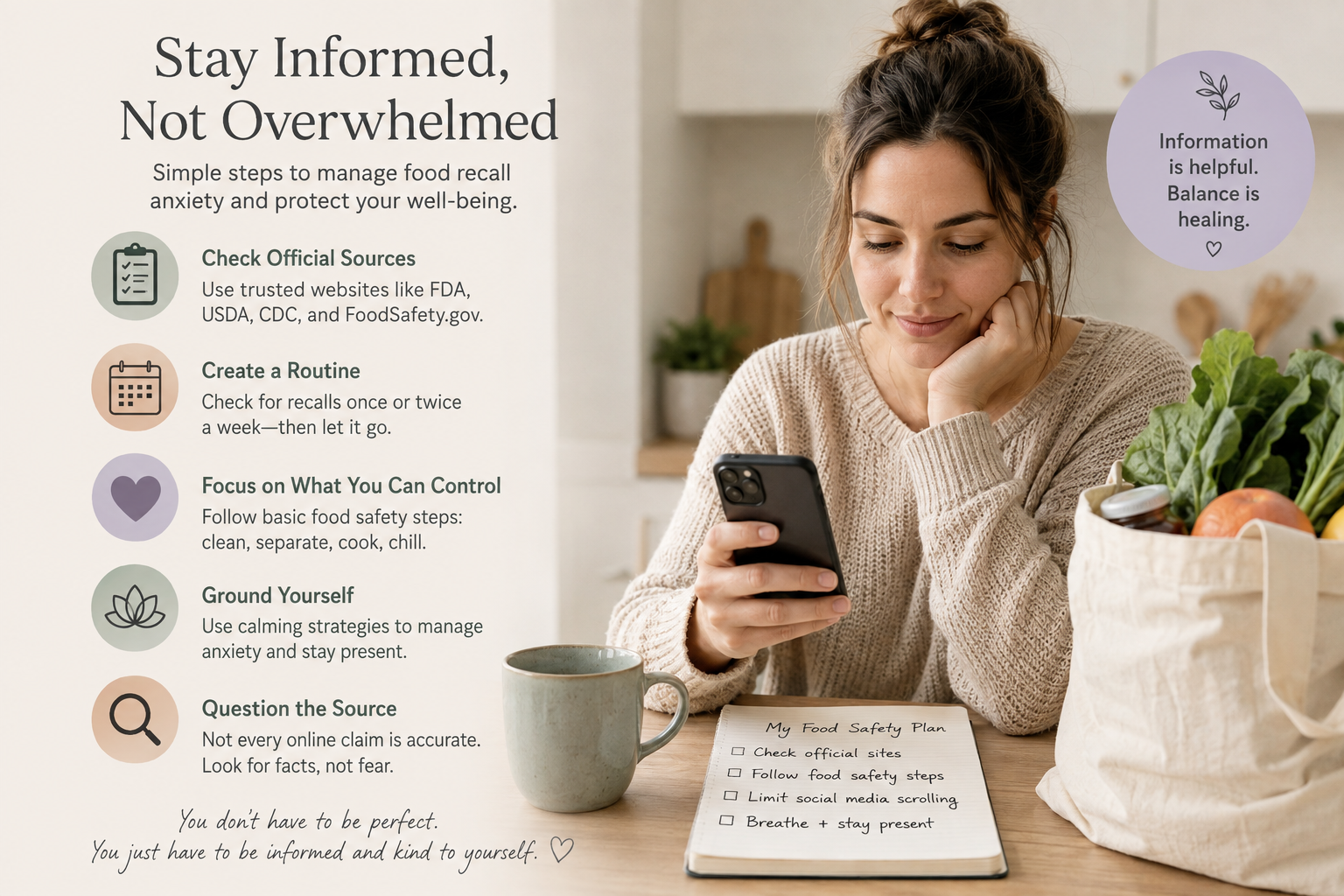
Create a Simple Food Recall Check Routine
If food recalls are triggering anxiety, checking constantly may feel protective, but it can actually reinforce the worry cycle. Your brain learns, “I only feel safe if I check again.” Then the relief wears off, and the urge to check returns.
Instead, try creating a simple routine.
For example:
Check official recall sources once or twice per week.
Check before using a product only if you have a specific concern.
Avoid scrolling social media for food safety updates late at night.
Save official recall pages so you do not rely on random posts.
Decide ahead of time how long you will spend checking.
This gives your brain structure. It says, “I am not ignoring safety, but I am also not giving anxiety unlimited access to my day.”
What to Do If You See a Recall
If you see a recall that might apply to something you bought, take it one step at a time.
Find the official recall notice.
Compare the product name, brand, lot number, best-by date, and packaging details.
Follow the instructions in the recall notice.
Do not eat the recalled product.
Clean any surfaces or storage areas if advised.
Contact the store, manufacturer, or official agency if you need clarification.
Contact a healthcare provider if you believe you became ill or if you are in a higher-risk group.
You do not need to throw out your entire kitchen because one product was recalled. Anxiety loves dramatic solutions. Food safety usually asks for specific ones.
Use Basic Food Safety Habits as an Anchor
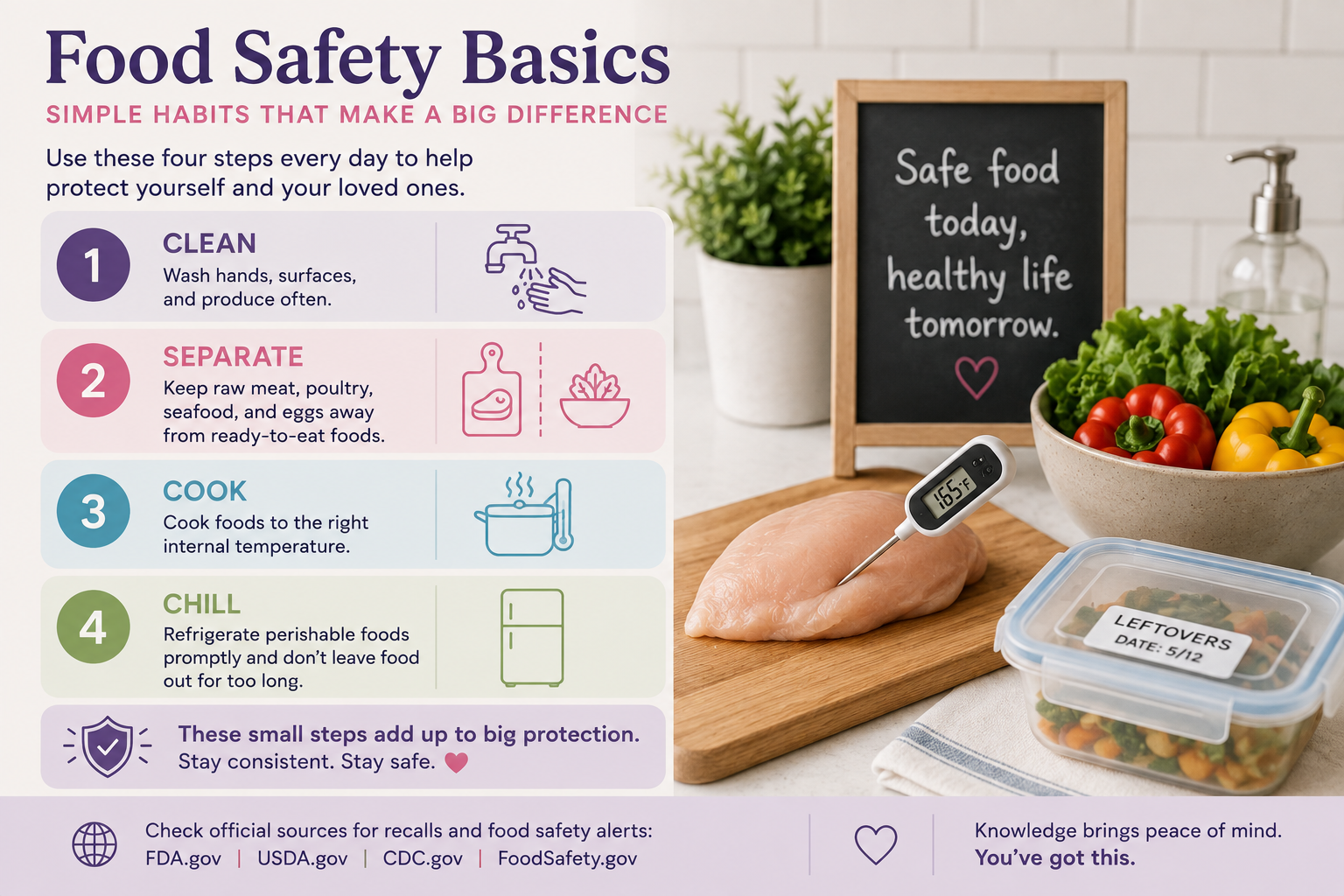
When the news feels overwhelming, returning to basic food safety practices can help you feel more grounded. The CDC and FoodSafety.gov emphasize four basic steps: clean, separate, cook, and chill.
That means:
Wash hands, surfaces, and produce when appropriate.
Keep raw meat, poultry, seafood, and eggs separate from ready-to-eat foods.
Cook foods to safe internal temperatures.
Refrigerate perishable foods promptly.
These habits do not eliminate every possible risk, but they reduce risk in meaningful, evidence-based ways.
For anxious minds, routines can be helpful because they shift the focus from “What if everything is dangerous?” to “Here is what I can reasonably do.”
Reasonable action is different from compulsive control.
When Food Safety Concern Turns Into Anxiety
It is healthy to care about food safety. It becomes more concerning when the worry begins to interfere with your life.
You may be dealing with anxiety if you notice:
Repeatedly checking recalls even after confirming your food is not affected
Avoiding many foods because of fear, not medical advice
Feeling panicked while grocery shopping
Throwing away large amounts of food “just in case”
Asking others for reassurance over and over
Having trouble eating because you feel unsafe
Spending excessive time researching food risks
Feeling unable to trust your own judgment
Having physical anxiety symptoms such as nausea, racing heart, tight chest, or restlessness
Feeling ashamed or frustrated because you “know” the fear is too big but cannot turn it off
Anxiety is not a character flaw. It is a nervous system trying very hard to protect you, sometimes by overestimating danger.
Therapy can help you respond to that fear without letting it run the entire kitchen.
Try the “Circle of Control” Approach
When anxiety feels big, it can help to sort concerns into three categories.
What I can control
Checking official recall sources at planned times
Reading product labels and lot numbers when needed
Following basic food safety practices
Cooking and storing food safely
Asking a healthcare provider about personal risk factors
Limiting doom-scrolling
Choosing trusted information sources
What I can influence
Helping family members understand recall instructions
Sharing verified information instead of rumors
Reporting a food safety concern if needed
Encouraging safe food handling at home
What I cannot fully control
Whether recalls happen
Whether every online claim is true
Whether companies make mistakes
Whether other people follow food safety practices
Whether all risk can be eliminated
The point is not to become careless. The point is to stop assigning yourself responsibility for things no person can fully control.
Be Careful With Reassurance Loops
When anxiety spikes, reassurance can feel like relief.
You may ask:
“Do you think this is safe?”
“Can you check this date?”
“Should I throw this away?”
“Are you sure?”
“Can you Google it again?”
Getting support is not wrong. But if reassurance becomes repeated and urgent, it may strengthen anxiety over time. The brain learns that uncertainty is unbearable and must be resolved immediately.
A more helpful approach may sound like:
“I checked the official recall source once. This product does not match the recall. I am going to tolerate the uncertainty and move on.”
That may feel uncomfortable at first. That does not mean it is unsafe. It means your anxiety is learning a new pattern.
Make a Food Safety Plan Before You Are Anxious
Anxiety is not known for its excellent executive functioning. When you are already activated, it is harder to think clearly.
Creating a simple plan ahead of time can help.
Your plan might include:
The official websites you will check
How often you will check them
What you will do if you find a recalled product
Who you will contact if you have a health concern
How you will limit social media food-scare content
What grounding skill you will use when anxiety spikes
A plan turns panic into steps.
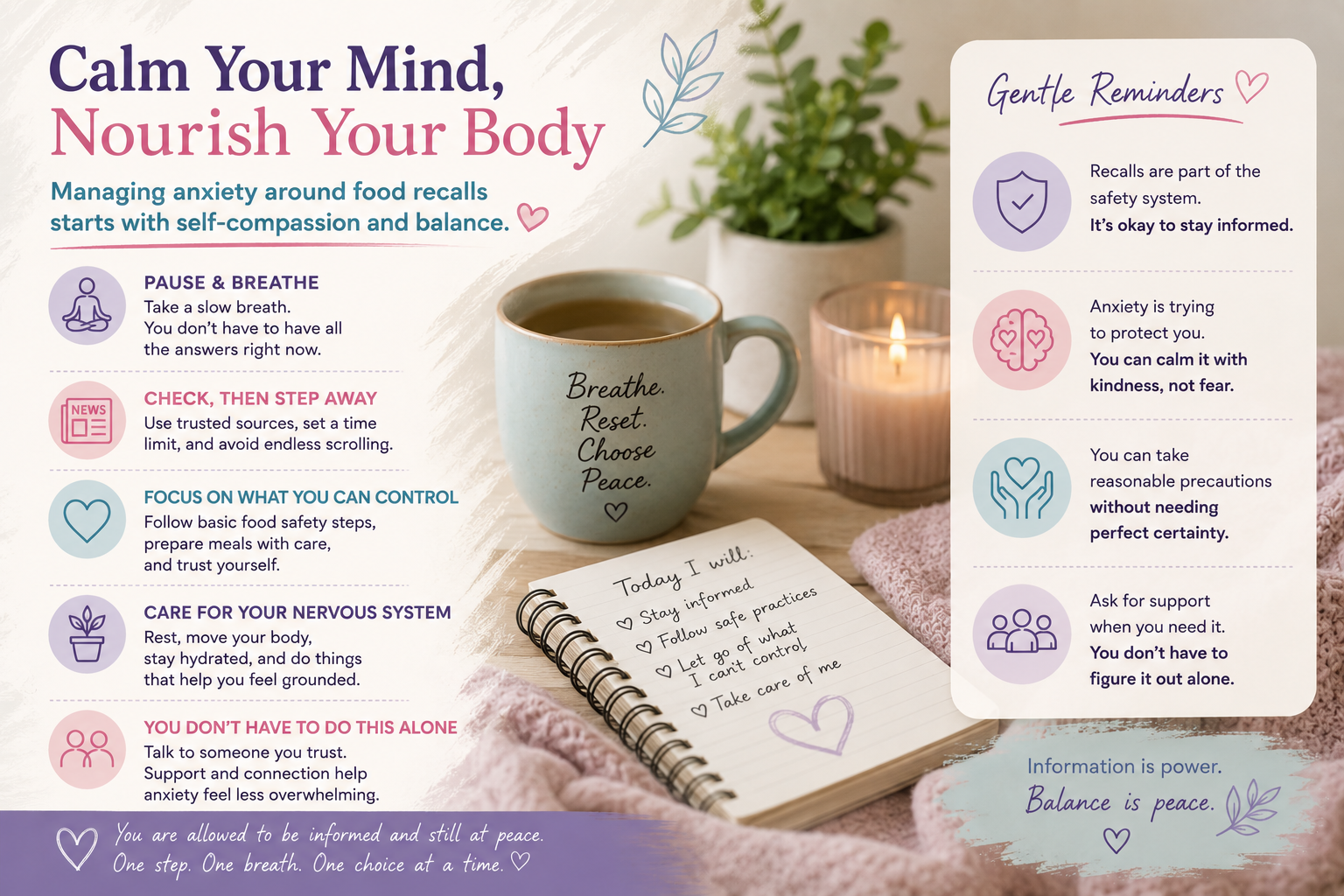
Grounding Skills for Food Recall Anxiety
When your body feels alarmed, try grounding before researching more.
You might try:
Put both feet on the floor and name five things you can see.
Take a slow breath and extend the exhale.
Hold a warm mug or cool glass and notice the temperature.
Step away from your phone for ten minutes.
Say, “This is anxiety. I can respond without spiraling.”
Remind yourself, “I can check reliable information without checking endlessly.”
Do one practical task: wash produce, clean a counter, put food away, or make a simple meal.
Grounding does not make the concern disappear. It helps bring your nervous system back into the present moment so you can make a clearer decision.
Support Matters, Especially If Food Anxiety Connects to Something Deeper
Sometimes food recall anxiety is not only about food.
It may connect to a history of medical trauma, poverty, caregiving responsibility, chronic illness, pregnancy loss, eating concerns, obsessive-compulsive patterns, childhood instability, or a deep fear that one small mistake could lead to harm.
If the fear feels larger than the situation, that does not mean you are “overreacting.” It may mean the situation is touching an older or more sensitive part of your nervous system.
Therapy can help you understand what is being activated, build coping tools, reduce compulsive checking, and make decisions from a place of steadiness rather than panic.
Final Thoughts
Food recalls are real. Food safety matters. It is wise to stay informed.
But staying informed should not require living in constant fear.
You are allowed to take reasonable precautions without making anxiety the manager of every meal. You are allowed to check official sources and then stop checking. You are allowed to care about safety without believing every frightening claim online. You are allowed to eat, shop, cook, and live without needing perfect certainty.
If anxiety about recalls, contamination, illness, or food safety is starting to interfere with your daily life, support is available.
At Prism Psychotherapy, therapy can help you sort through anxiety, build practical coping strategies, and reconnect with a sense of trust in yourself.
You do not have to choose between being informed and being at peace.
You can practice both.
SOURCES:
Food recalls and safety alerts are published through official sources including the FDA, USDA-FSIS, CDC, and FoodSafety.gov; FDA explains that recalls may happen when food is mislabeled, contaminated, or otherwise may present a health hazard.
FoodSafety.gov provides a centralized place to search recall and outbreak information, while FDA and USDA-FSIS maintain current recall and public health alert pages.
CDC and FoodSafety.gov recommend four basic food safety steps: clean, separate, cook, and chill.
NIMH notes that anxiety symptoms can interfere with daily routines and that some people benefit from psychotherapy, support groups, sleep, and reducing caffeine as part of anxiety care.
FoodSafety.gov explains how consumers can report food problems and where to report concerns depending on the type of product.
