

Grieving the Mother You Needed But Did Not Have
Mother-daughter relationships are often described as automatically nurturing, close, and uncomplicated.
But for many people, that is not the reality.
Some daughters grow up with mothers who were emotionally unpredictable, critical, dismissive, controlling, absent, overwhelmed, abusive, dependent, or unable to offer consistent care. Some mothers loved their children deeply but were limited by their own trauma, mental health struggles, addiction, grief, or survival patterns. Some relationships were not entirely harmful, but they weren’t fully safe either.
That kind of relationship can leave a lasting wound.
And one of the hardest parts is this: you may still grieve your mother even if the relationship hurt you.
You may grieve the mother you had.
You may grieve the mother you needed.
You may grieve the version of the relationship you kept hoping would appear.
This grief can be confusing, especially when the person is still alive, when the relationship has both loving and painful memories, or when other people tell you, “But she’s your mother.”
At Prism Psychotherapy, we believe complicated family grief deserves care, nuance, and compassion. Healing does not require pretending the pain was fine. It also does not require reducing a whole relationship to one simple label.
Sometimes healing begins by telling the truth: “This relationship shaped me, and some parts of it still hurt.”

What Is the Mother Wound?
The phrase “mother wound” is not a formal diagnosis. It is a common way people describe the emotional pain that can come from an unmet, unsafe, or complicated relationship with a mother or mother figure.
This wound may come from obvious harm, such as verbal abuse, emotional neglect, manipulation, rejection, parentification, or abandonment. It may also come from quieter patterns, such as never feeling emotionally seen, being expected to manage a parent’s feelings, being criticized more than comforted, or learning that love was conditional.
For some people, the wound is connected to what happened. For others, it is connected to what never happened.
The apology that never came.
The comfort that was never offered.
The protection that was missing.
The acceptance that always felt out of reach.
The mothering you had to learn to give yourself.
This kind of grief can be hard to name because it does not always look like a single traumatic event. Sometimes it is a long pattern of emotional injury.

How Painful Mother-Daughter Relationships Can Shape Adult Life
When a child grows up in a relationship where love feels unpredictable, critical, conditional, or emotionally unsafe, they often learn ways to survive.
Those survival strategies may have helped at the time. But in adulthood, they can become exhausting.
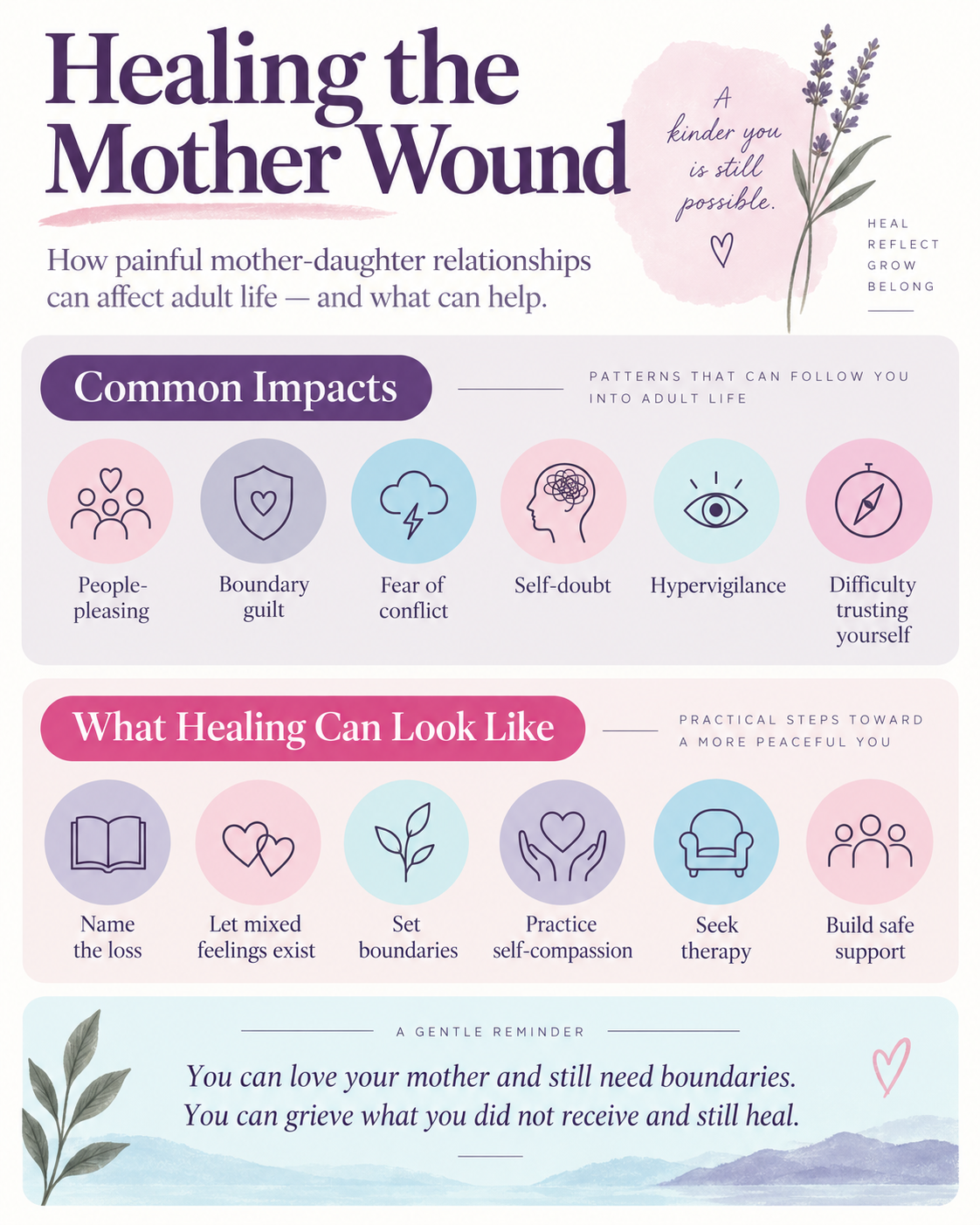
A person may notice patterns such as:
Feeling responsible for everyone else’s emotions
Apologizing even when they did nothing wrong
Struggling to set boundaries without guilt
Overexplaining themselves to avoid conflict
Feeling anxious when someone is upset with them
Choosing partners or friends who feel familiar but not safe
Difficulty trusting their own memory or judgment
Feeling “too much” and “not enough” at the same time
Becoming hyper-independent because relying on others felt unsafe
Feeling numb, detached, or emotionally flooded during conflict
These responses are not personality flaws. They are often adaptations.
A nervous system that learned to scan for criticism, rejection, mood changes, or emotional danger may continue doing that long after childhood is over.
Therapy can help clients understand these patterns with compassion instead of shame.
The Grief of Still Wanting What You Did Not Receive
One of the most painful parts of mother-daughter relationship trauma is the grief of longing.
You may know, logically, that your mother may never become the person you needed her to be. But emotionally, part of you may still hope.
Maybe one conversation will finally change things.
Maybe she will understand this time.
Maybe she will apologize.
Maybe she will choose you.
Maybe she will become softer, safer, kinder, or more accountable.
That hope can be deeply human. It can also be heartbreaking.
Grieving the mother you needed does not mean you are ungrateful. It does not mean you are cruel. It does not mean there were no good moments. It means you are allowing yourself to acknowledge the gap between what you needed and what you received.
That gap matters.
When the Relationship Is Both Loving and Painful
Some mother-daughter relationships are not easy to categorize.
Maybe your mother could be generous and hurtful. Loving and controlling. Proud of you and critical of you. Present in practical ways but absent emotionally. Protective sometimes and unsafe other times.
This can create emotional confusion because the mind wants a clean answer: Was she good or bad? Was it love or harm? Should I stay close or step back?
Often, the truth is more complicated.
A relationship can include love and injury.
A mother can have her own pain and still be responsible for how she treated you.
You can understand why someone became who they are without excusing the impact of their behavior.
You can love someone and still need boundaries.

Boundaries Are Not Betrayal
For many people with mother-daughter relationship trauma, boundaries feel terrifying.
A boundary may bring up guilt, fear, shame, or the old belief that you are being selfish. You may worry that setting limits means you are abandoning your mother, being disrespectful, or becoming “the bad one.”
But boundaries are not punishments.
Boundaries are a way of protecting your emotional safety and clarifying what you can and cannot participate in.
A boundary may sound like:
“I’m not willing to discuss my body or appearance.”
“If yelling starts, I’m going to end the conversation.”
“I can visit for two hours, but I’m not staying overnight.”
“I’m not available to be the person who manages everyone’s emotions.”
“I need some time before responding.”
“I am allowed to make decisions that are right for my life.”
Healthy boundaries do not require the other person to agree. They require you to know what you will do to care for yourself.
That can take practice.
Especially if you were taught that love meant having no limits.
When Your Mother Has Died
If your mother has died, the grief can become even more layered.
Death may bring sadness, relief, guilt, anger, regret, longing, numbness, or confusion. Some people feel pressure to remember only the good. Others feel ashamed if they are not grieving in a way that looks “normal.”
But complicated relationships often create complicated grief.
When a mother dies, a daughter may grieve the actual person, the relationship as it was, and the relationship that can no longer be repaired in the way she hoped. There may be grief over unfinished conversations, missing apologies, unresolved conflict, or the realization that certain questions may never be answered.
This does not mean healing is impossible.
It means healing may involve making peace with complexity rather than forcing closure.
Closure is not always a final conversation. Sometimes closure is the decision to stop abandoning yourself while waiting for someone else to become ready.

The Role of Therapy in Healing Mother-Daughter Trauma
Therapy can offer a steady space to explore painful family patterns without minimizing what happened or rushing toward forgiveness.
In therapy, clients may work on:
Naming what was hurtful or missing
Understanding survival patterns and nervous system responses
Reducing guilt and self-blame
Building boundaries that feel realistic
Processing grief, anger, sadness, and longing
Learning to trust their own perspective
Exploring how early family dynamics affect adult relationships
Practicing self-compassion
Deciding what kind of contact, if any, feels healthy
Building a life that is not organized around old wounds
Therapy is not about blaming your mother forever.
It is about helping you stop blaming yourself.
Healing Does Not Have to Look One Way
Some people heal while staying in contact with their mother.
Some people heal with limited contact.
Some people heal after no contact.
Some people heal after a mother’s death.
Some people heal while still feeling love, anger, grief, compassion, and exhaustion all at once.
There is no universal right answer. There is only the question of what supports your safety, dignity, and emotional health.
Healing may mean grieving what you did not receive. It may mean learning to mother yourself with more tenderness. It may mean allowing other safe relationships to matter. It may mean becoming the kind of person to yourself that you needed someone else to be.
You are allowed to want love without control.
You are allowed to want closeness without fear.
You are allowed to protect your peace without proving your pain to everyone else.
Final Thoughts
A painful mother-daughter relationship can shape how you see yourself, how you love, how you set boundaries, and how safe you feel in the world. But those patterns are not permanent.
You can understand where they came from.
You can grieve what was missing.
You can build relationships that feel steadier, kinder, and more mutual.
And you can begin to separate your worth from the care you did or did not receive.
At Prism Psychotherapy, we support clients navigating grief, trauma, family wounds, identity, boundaries, and life transitions. If your relationship with your mother still hurts, therapy can help you explore that pain with honesty, compassion, and care.
You do not have to keep carrying it alone.
Source Notes
Research and clinical literature recognize that adverse childhood experiences and psychological maltreatment can affect adult mental health, self-image, relationships, and emotional regulation.
NAMI notes that trauma-related conditions can affect self-perception, relationships, and the ability to regulate emotions, especially when trauma is chronic or complex.
Mother-daughter relationships remain developmentally and emotionally significant across adulthood, and grief after a mother’s death can be shaped by the quality and complexity of the lifelong relationship.
A 2025 cross-sectional study on mother loss found that a mother’s death can have biopsychosocial impacts for adult daughters, including associations with depression, anxiety, stress, PTSD symptoms, prolonged grief symptoms, quality of life, sleep disturbance, and pain.
