

Paying for Therapy: Understanding Insurance, Sliding Scales, and Your Options
Starting therapy can bring up a lot of questions.
What kind of therapist do I need?
Will I feel comfortable talking to this person?
How often should I go?
And, very understandably: How am I going to pay for this?
The cost of therapy can feel intimidating, especially when you are already dealing with grief, anxiety, trauma, stress, relationship strain, identity concerns, or a major life transition. Money should not be a shame-filled topic in therapy. It is part of real life, and it is okay to ask clear questions before beginning care.
At Prism Psychotherapy, we encourage clients to talk openly about payment options, insurance questions, and sliding scale availability. Prism’s website notes that services may be offered through an exchange-for-service sliding scale fee and encourages clients to contact their insurance carrier to determine coverage and copay information. The most accurate information about your specific benefits will always come from your insurance plan, but your therapist can often help you understand what questions to ask.
Why Paying for Therapy Can Feel So Confusing
Therapy payment can be confusing because there is no single system that works the same way for everyone. Some clients use insurance. Some pay privately. Some use out-of-network benefits. Some use a sliding scale. Some use health savings accounts or flexible spending accounts. Some combine options depending on their situation.
Even when a person has insurance, coverage may depend on several factors, including:
Whether the therapist is in-network or out-of-network
Whether the client has met their deductible
Whether there is a copay or coinsurance
Whether the plan covers outpatient mental health services
Whether telehealth is covered
Whether the diagnosis, service type, or session length meets the plan’s requirements
Whether the provider is licensed in the state where the client is located
This can feel like a lot, because it is a lot. Insurance language often makes people feel like they need a decoder ring, a law degree, and possibly a snack.
If you are unsure what your plan covers, you can contact your insurance carrier and ask directly about your outpatient behavioral health or psychotherapy benefits.
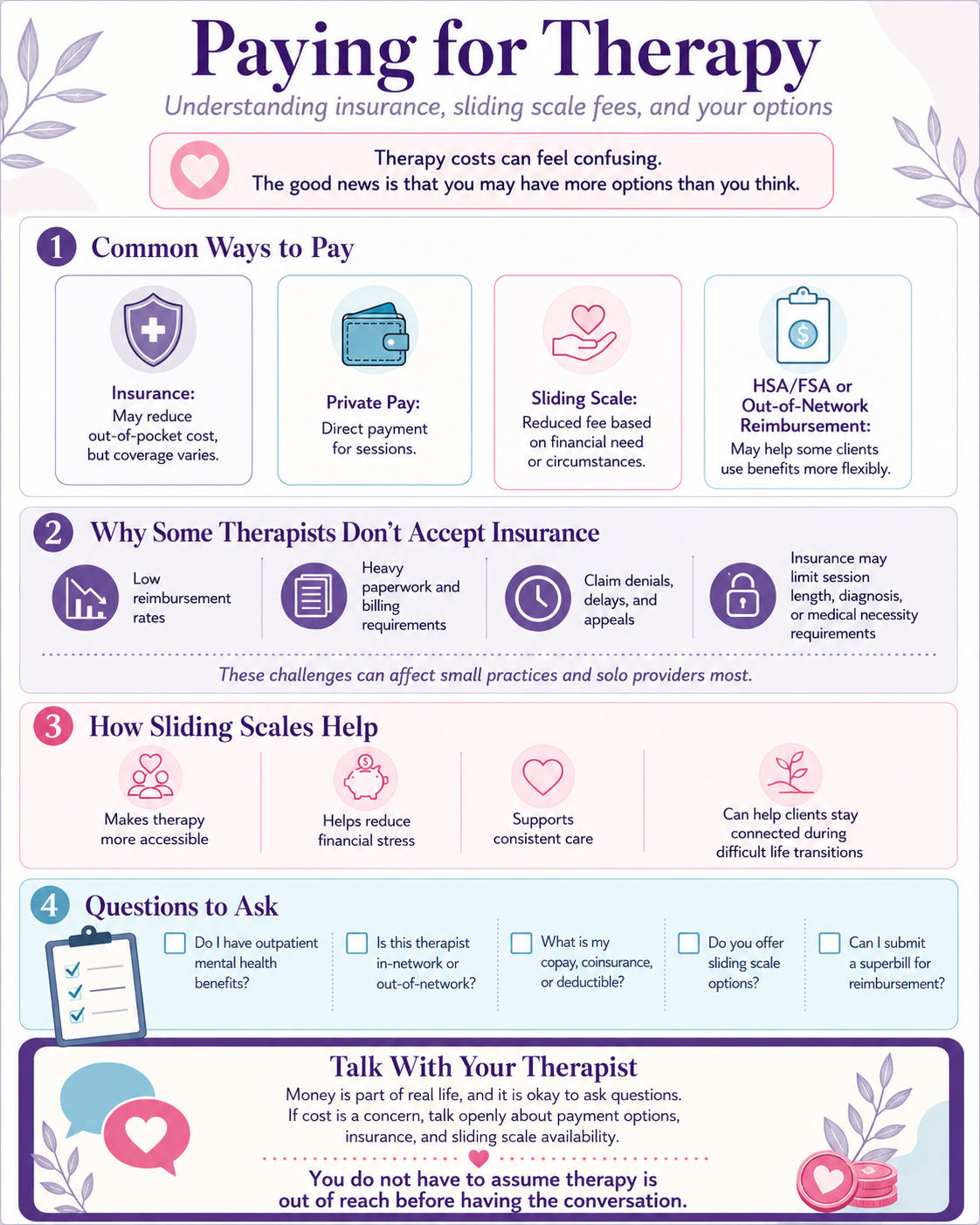
Common Questions to Ask Your Insurance Company
Before starting therapy, it may help to call the number on the back of your insurance card and ask:
Do I have outpatient mental health benefits?
Is this therapist in-network or out-of-network?
Do I have a deductible? If yes, how much is left before benefits begin?
What is my copay or coinsurance for individual psychotherapy?
Are telehealth therapy sessions covered?
Do I need prior authorization?
Are there limits on the number of sessions per year?
What is the process for submitting out-of-network claims?
Can I use a superbill for reimbursement?
Are there specific diagnosis or documentation requirements?
It is also helpful to write down the date of the call, the name of the representative, and any reference number they provide. Insurance information can change, and keeping notes may help if there is confusion later.
Why Some Therapists Do Not Accept Insurance
Many people wonder why every therapist does not simply accept every insurance plan. It is a fair question.
Insurance can make therapy more affordable for clients, and many therapists deeply value access to care. At the same time, accepting insurance can create significant challenges for providers, especially solo practitioners and small practices.
According to the American Psychological Association, high demand for mental health treatment continues, but administrative and financial barriers have made it difficult for some psychologists to participate in insurance networks. APA’s 2024 Practitioner Pulse Survey highlighted concerns such as low reimbursement rates, administrative burden, payment reliability, and coverage denials. These barriers can affect whether providers are able to remain in-network with insurance companies.
For therapists, accepting insurance often involves:
Credentialing applications that can take months
Contracting with each insurance company separately
Claim submission and follow-up
Denial management and appeals
Documentation requirements
Audits or record requests
Delayed payments
Restrictions around session length, diagnosis, or medical necessity
Time spent on administrative tasks instead of clinical care
These issues are not unique to therapy. Across health care, providers report that insurance-related processes, including prior authorization, can delay care and increase administrative burden. The American Medical Association has reported that prior authorization requirements are a major source of physician burden and can negatively affect patient care.
In therapy specifically, these administrative demands can be especially difficult for small practices. A therapist may be seeing clients, writing notes, managing scheduling, responding to crisis concerns, handling billing, tracking payments, answering insurance questions, and maintaining licensure and continuing education requirements.
That does not mean insurance is “bad” or that private pay is automatically better. It means the system is complicated, and the decision to accept insurance is not always simple.
Insurance Can Help Clients — But It Can Also Have Limits
Insurance can make therapy more financially accessible for many people. For some clients, using insurance is the only realistic way to receive ongoing care. That matters.
However, insurance-based care may also come with limits. Insurance companies often require a mental health diagnosis for reimbursement. They may review documentation, determine whether services are considered medically necessary, or limit certain types of care. Claims may also be denied for administrative reasons, even when care was provided.
KFF reported that insurers offering qualified health plans on HealthCare.gov denied about 20% of all claims in 2024, including 19% of in-network claims and 37% of out-of-network claims. Not every denied claim involves therapy, but the data show why many clients and providers experience insurance as unpredictable.
This is why it is important to understand your benefits before beginning therapy, especially if you plan to use out-of-network reimbursement.
What Is a Sliding Scale?
A sliding scale is a reduced fee structure that allows some clients to pay less than the therapist’s full standard rate based on financial need or other circumstances.
Sliding scales can make therapy more accessible for people who may not be able to afford the full private-pay rate but still need consistent support. This may include people who are uninsured, underinsured, between jobs, managing medical debt, caregiving, supporting dependents, or experiencing financial strain.
A sliding scale is not a discount because therapy is less valuable. It is a way of making care more reachable.
For clients, sliding scale therapy may help by:
Reducing financial stress
Making regular sessions more realistic
Increasing access for people without usable insurance benefits
Helping clients stay connected to care during difficult transitions
Offering more privacy for those who do not want to use insurance
Supporting continuity when insurance benefits are limited or confusing
For therapists, sliding scales can be one way to balance access and sustainability. Most providers cannot offer unlimited reduced-fee spots, because practices still have operating costs. But when available, sliding scale options can help bridge the gap between the care people need and what they can realistically afford.
Private Pay, Insurance, and Sliding Scale: None of These Are Moral Categories
It is easy for people to feel embarrassed about money. Some clients feel ashamed that they need a lower fee. Others feel guilty paying privately. Some feel frustrated that their insurance is not easier to use. Some avoid asking questions because they do not want to seem “difficult.”
None of that shame belongs here.
Needing a sliding scale does not mean you are failing.
Using insurance does not mean you are less committed to therapy.
Private pay does not mean your pain is more legitimate.
Asking questions about cost does not make you a burden.
Therapy works best when practical realities can be discussed honestly. Payment is one of those realities.
How to Talk With a Therapist About Payment
If you are interested in therapy but worried about cost, you can say something simple:
“I’m interested in starting therapy, but I need to understand the cost before I commit. Do you offer sliding scale options or out-of-network superbills?”
Or:
“I have insurance, but I’m not sure what it covers. Can you tell me whether you are in-network or private pay?”
Or:
“I want to make therapy sustainable. Can we talk about session frequency and payment options?”
A good therapist should be able to discuss fees clearly and respectfully. They may not be able to meet every financial need, but they should not shame you for asking.
Other Ways to Make Therapy More Sustainable
Depending on the therapist and your clinical needs, you may be able to discuss:
Weekly sessions during a more intense period, then reducing frequency later
Biweekly sessions when clinically appropriate
Short-term therapy focused on a specific concern
Sliding scale availability
Out-of-network reimbursement
Superbills for insurance submission
HSA or FSA payment options, if applicable
Community resources or support groups alongside therapy
Referrals to lower-cost clinics if needed
Not every option will be right for every person. For example, someone in acute crisis may need a higher level of care or more frequent support. But for many clients, there may be more flexibility than they initially realize.
A Note About Superbills and Out-of-Network Benefits
Some therapists who do not bill insurance directly can provide a superbill. A superbill is a detailed receipt that clients may submit to their insurance company for possible out-of-network reimbursement.
A superbill typically includes information such as dates of service, fees paid, diagnosis codes, provider information, and service codes. Reimbursement is not guaranteed. It depends on your insurance plan.
Before relying on out-of-network reimbursement, ask your insurance company:
Do I have out-of-network mental health benefits?
What percentage do you reimburse?
Is there an out-of-network deductible?
Has any of that deductible been met?
What documentation do I need to submit?
Is telehealth reimbursable out of network?
How long does reimbursement usually take?
This can help prevent surprise costs later.
Therapy Is an Investment — But It Should Still Be Discussed Honestly
Therapy can support people through grief, trauma, anxiety, depression, identity exploration, relationship pain, burnout, caregiving stress, and major life transitions. It can help people understand patterns, build coping skills, strengthen boundaries, process painful experiences, and feel less alone.
That does not erase the fact that therapy costs money.
Both truths can exist: therapy can be valuable, and paying for therapy can be stressful.
At Prism Psychotherapy, we believe clients deserve clear, compassionate conversations about care, including the financial part. If cost is a concern, it is okay to bring it up. If you are unsure how insurance works, it is okay to ask. If you need to understand whether sliding scale options are available, it is okay to start there.
You do not have to silently decide therapy is out of reach before having the conversation.
Final Thoughts
Paying for therapy can feel overwhelming, especially in a health care system that is often confusing and frustrating. Insurance may help, but it can also bring limitations and administrative barriers. Private pay may offer flexibility, but it may not be affordable for everyone. Sliding scale fees can help make therapy more accessible when full-rate care is not realistic.
The most important first step is communication.
Ask the questions. Talk about your options. Let your therapist know what you need to understand before beginning.
Therapy is about care, safety, honesty, and support. The conversation about payment should be handled with the same respect.