

When Someone Is Still Here, but the Relationship Is Gone: Understanding Ambiguous Loss
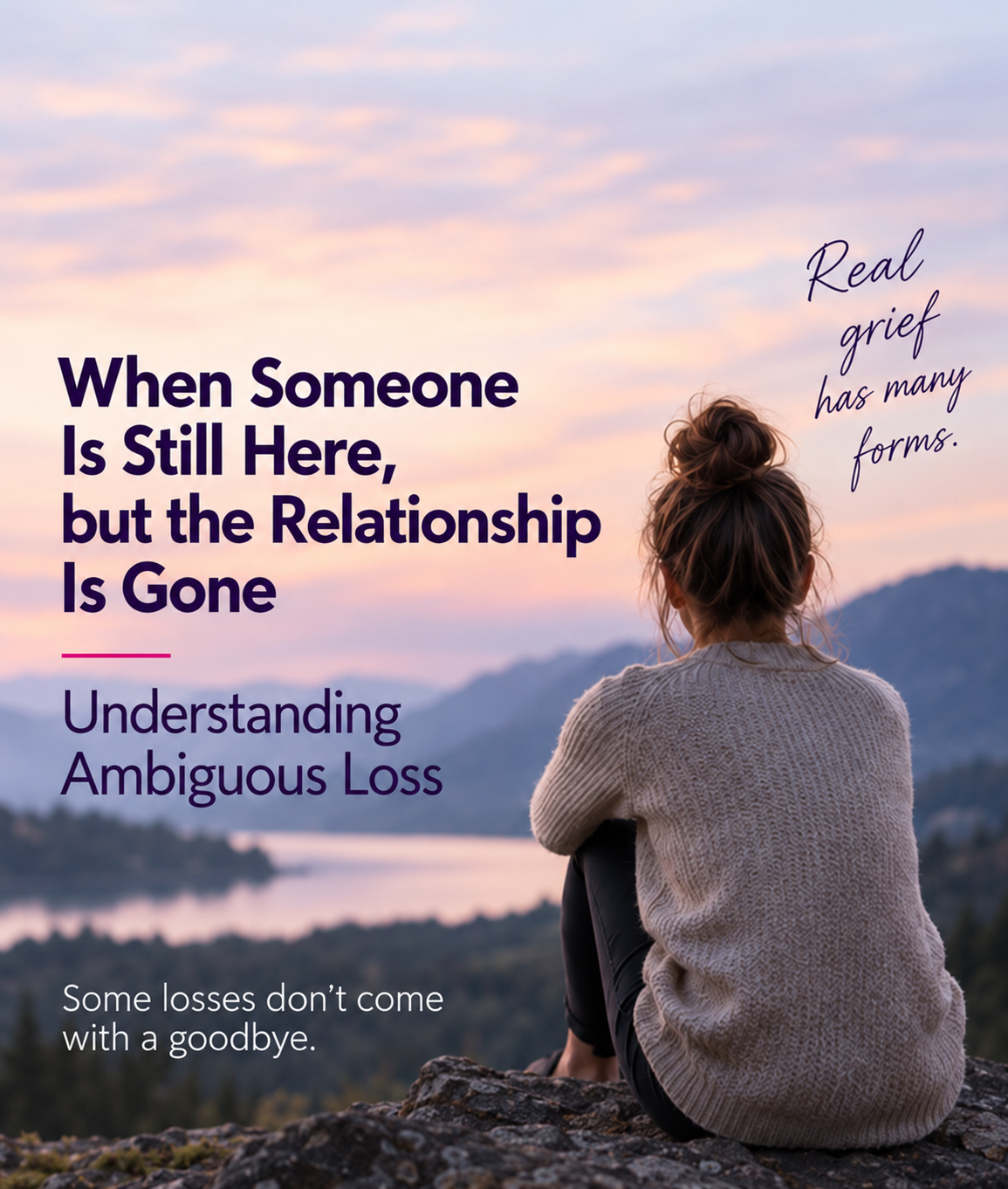
Some losses come with a clear ending.
A death.
A goodbye.
A final conversation.
A date you can circle on a calendar and say, “This is when everything changed.”
Other losses are much harder to define.
The person may still be alive, but the relationship has changed completely. Someone you love may be physically present but no longer emotionally or cognitively available. A relationship may end without a real ending. A family member may disappear from your life without explanation. You may still love someone deeply while also knowing that the relationship you once had no longer exists.
This experience has a name: ambiguous loss.
Ambiguous loss can be particularly painful because there is often no clear moment when grieving is supposed to begin — and no obvious point when it is supposed to end.
You may find yourself wondering:
Am I allowed to grieve someone who is still alive?
Yes.
Sometimes one of the hardest forms of grief is mourning a person or relationship that still exists in some form, but not in the way you need or remember.
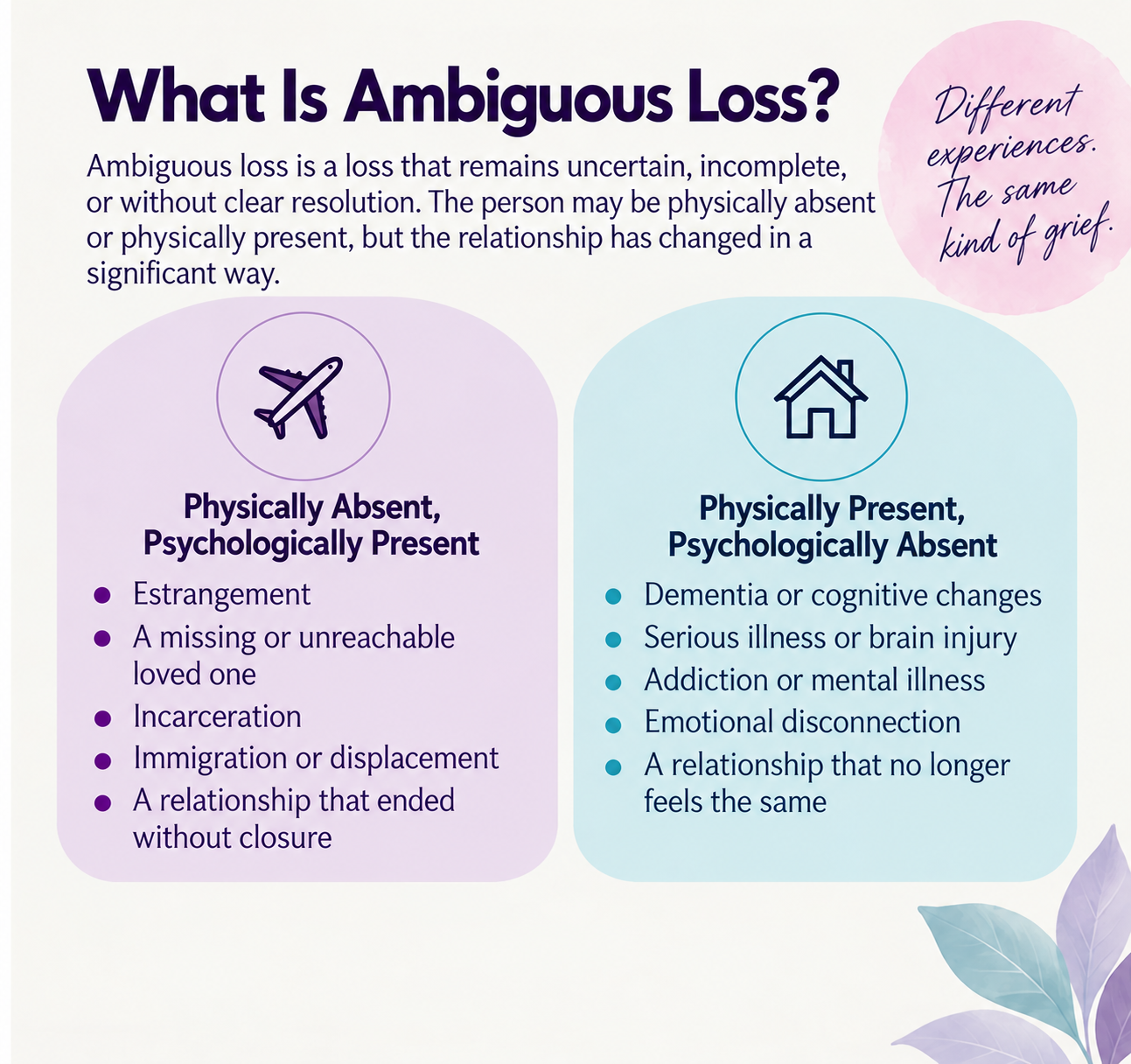
What Is Ambiguous Loss?
The concept of ambiguous loss was developed by family therapist and researcher Dr. Pauline Boss.
At its core, ambiguous loss describes a loss that remains uncertain, incomplete, or without clear resolution.
Boss identified two broad forms.
Someone is physically absent but psychologically present
The person is not physically available, but remains emotionally and psychologically present in your life.
This may happen when:
A person is missing
A family member has disappeared or become unreachable
Immigration or displacement separates loved ones indefinitely
A family member is incarcerated
A parent leaves without meaningful explanation
A relationship ends without emotional closure
You may not know whether to keep hoping, begin grieving, stay connected, or let go.
Someone is physically present but psychologically absent
The person is still physically there, but something significant about the relationship has changed.
This can occur with:
Dementia or Alzheimer's disease
Severe neurological illness
Traumatic brain injury
Serious mental illness
Addiction
Major changes caused by chronic illness
Relationships in which emotional connection has disappeared
A loved one may still be sitting beside you, but the relationship you knew may feel unreachable.
Both experiences can create the same painful contradiction:
Someone is here — and somehow, they are also gone.
Why Ambiguous Loss Can Be So Difficult
Traditional grief usually gives us something concrete to respond to.
There may be a funeral, a diagnosis, a breakup conversation, a goodbye, or a community that recognizes what happened.
Ambiguous loss often gives us none of that.
Instead, there is uncertainty.
Your mind may keep looking for an answer:
Is this relationship really over?
Will they come back?
Will my mother remember me tomorrow?
Will my sibling ever speak to me again?
Is the person I knew still in there?
Should I keep trying?
Should I let go?
How do I grieve when I do not even know what I am grieving?
This uncertainty can make it harder to create meaning around what has happened. Research on ambiguous loss has found that people facing unclear loss may have greater difficulty developing a coherent story about the experience than people dealing with a definite loss.
In plain language: our brains like endings.
Ambiguous loss refuses to provide one.
The Grief of Estrangement
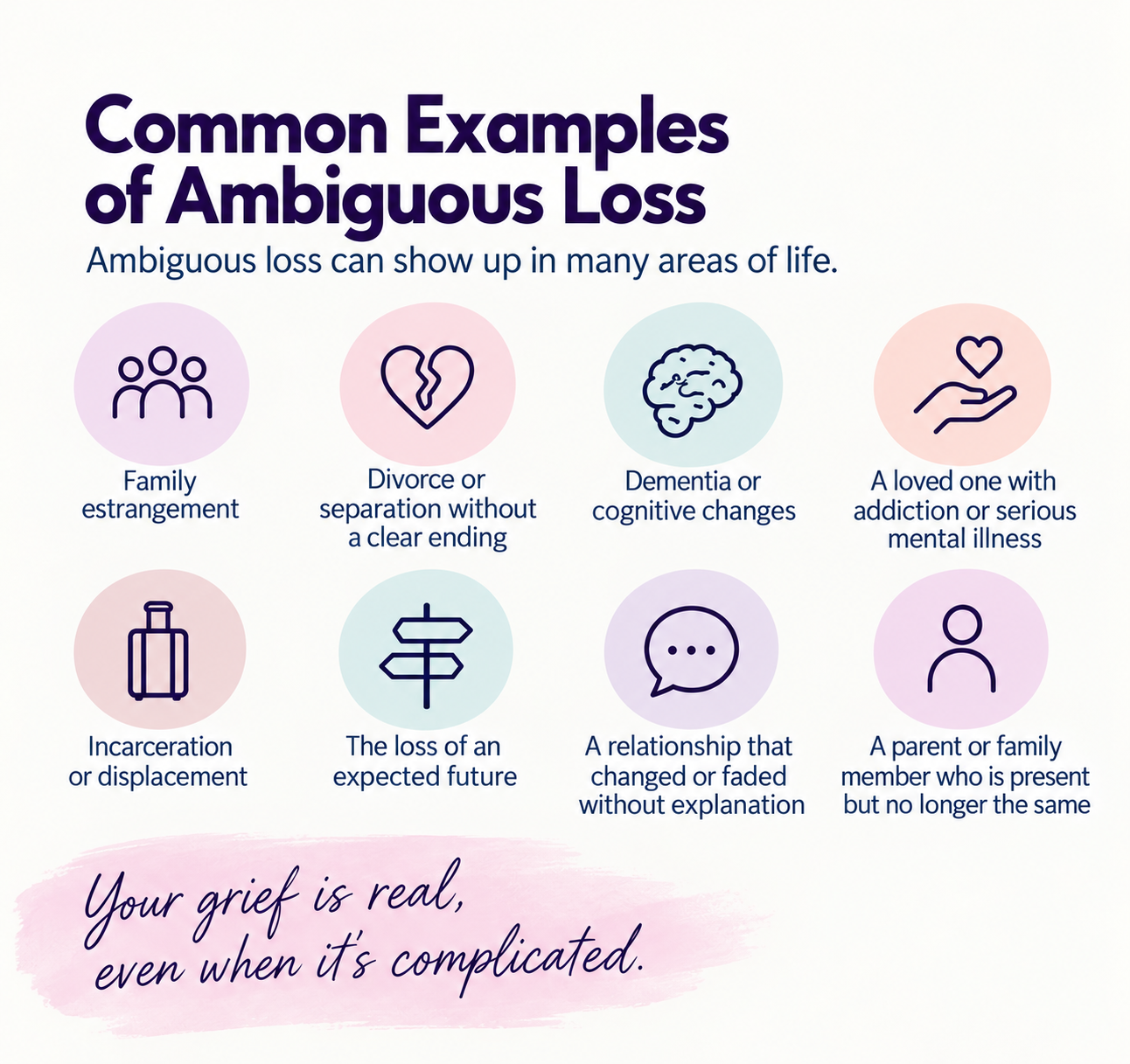
Family estrangement can contain many elements of ambiguous loss.
A parent, sibling, adult child, or other family member may still be alive, yet no longer be part of your daily life.
Sometimes there was a clear conflict. Sometimes contact faded gradually. Sometimes one person created distance while the other person never fully understood why.
Estrangement can leave people caught between grief and hope.
You may miss someone while also knowing that contact with them is painful.
You may replay conversations wondering what you could have done differently.
You may wonder whether to reach out.
You may dread holidays, birthdays, weddings, illnesses, and family events because they remind you of what the relationship used to be — or what you wished it could have been.
And because no one has died, other people may not recognize that you are grieving.
They may say:
“But they're still your mother.”
“Why don't you just call?”
“Life is too short.”
“You'll regret not fixing this.”
Those statements may be well intentioned, but they can minimize the complexity of relationships that became unsafe, painful, or impossible to maintain.
Not every relationship can or should be repaired.
Sometimes grief involves accepting that love and distance can exist at the same time.
When Dementia Changes Someone You Love
Dementia is one of the clearest examples of ambiguous loss.
A person may remain physically present while memory, personality, communication, independence, and familiar roles gradually change.
A spouse may grieve the partner who once shared decisions with them.
An adult child may grieve the mother who no longer remembers their childhood.
A family may experience dozens of small losses over years rather than one single moment of loss.
Research involving families affected by Alzheimer's disease and related dementias has described this combination of physical presence and psychological absence as particularly distressing.
Caregivers may grieve:
Shared memories
Conversation
Independence
Familiar personality traits
Family roles
Future plans
The feeling of being recognized
The relationship as it once existed
And yet, love may still be present.
This creates an emotional reality that is difficult to explain:
You can be grateful someone is still here and heartbroken about what has changed.
Both can be true.
Divorce, Separation, and Relationships Without Clear Endings
Not every relationship ends cleanly.
Some couples separate without knowing whether they will reconcile or divorce. Others remain legally connected while emotionally disconnected. Some people experience years of uncertainty while relationships move between closeness and distance.
Research on ambiguous marital separation has found that this uncertainty can create loneliness and emotional strain precisely because the outcome remains unclear.
A person may not know whether they are rebuilding a relationship or mourning it.
They may feel unable to move forward because there is always a possibility that things could change.
That state of waiting can become its own form of emotional exhaustion.
Ambiguous Loss Can Also Be the Loss of a Future
Sometimes what disappears is not only a person.
It is the future you expected.
You may grieve:
The marriage you thought you would have
The family relationship you hoped would eventually improve
The retirement you planned with someone
The future you imagined before an illness or disability
The parent you expected to grow old with
The relationship you thought would finally become safe
The version of yourself you expected to become
These losses can be particularly difficult because you are grieving something that never fully existed.
But imagined futures matter.
We build emotional lives around expectations, hopes, relationships, plans, and possibilities.
When those disappear, grief can follow.
Why “Closure” May Not Be the Goal
People experiencing loss are often told they need closure.
But ambiguous loss may not offer it.
Dr. Pauline Boss has argued that expecting closure from unclear loss can actually make grieving harder. When there is no definitive ending, demanding emotional finality may leave people feeling as though they are failing at grief.
Sometimes healing means learning to live with unanswered questions.
You may never know why someone stopped speaking to you.
You may never receive the apology you hoped for.
A loved one's dementia may continue changing the relationship.
A former partner may never give you the explanation that finally makes everything make sense.
Healing does not always mean finding the answer.
Sometimes it means becoming more able to live without one.
You Can Hold Two Truths at Once
Ambiguous loss is full of contradictions.
You can love someone and not want contact with them.
You can miss someone who hurt you.
You can feel relieved and devastated at the same time.
You can hope someone changes while accepting that they may not.
You can enjoy a moment with someone who has dementia while grieving who they used to be.
You can forgive someone and still maintain a boundary.
You can decide not to forgive and still heal.
One of the most important parts of working through ambiguous loss is learning that two conflicting emotions can both be true.
Humans are complicated.
Relationships are complicated.
Grief is allowed to be complicated too.
Practical Ways to Cope With Ambiguous Loss
Ambiguous loss cannot always be solved. But it can become more manageable.
Name what you have lost
Try putting the loss into words.
Instead of simply saying, “Things are different,” you might say:
“I miss having a mother I could call when something happened.”
“I am grieving the marriage I thought we would have.”
“I miss who my father was before dementia.”
“I am grieving a sibling who is alive but no longer part of my life.”
Naming the loss gives shape to something that otherwise feels vague.
Stop requiring yourself to choose one emotion
You do not have to decide whether you are angry or sad.
You may be both.
You do not have to decide whether you love someone or resent them.
You may do both.
Making room for emotional contradiction can reduce the pressure to find one clean explanation for a complicated experience.
Build rituals even when there was no traditional loss
Humans use rituals to help make meaning.
You may want to:
Write a letter you never send
Light a candle
Visit a meaningful place
Create art
Save photographs or meaningful objects
Journal about what the relationship meant
Mark an anniversary privately
Create a new tradition
There does not need to be a funeral for grief to deserve acknowledgment.
Focus on what is known
Ambiguous loss pulls attention toward uncertainty.
When possible, gently return to what you do know.
You may not know whether an estranged relative will reconnect.
But you can know what kind of contact feels safe today.
You may not know exactly how dementia will progress.
But you can focus on today's conversation, today's care, or today's moment of connection.
You may not know why someone left.
But you can know what you need in relationships moving forward.
Allow relationships to change shape
Sometimes healing does not mean restoring a relationship to what it once was.
It means developing a new relationship with reality.
With dementia, connection may shift from conversation to music, touch, photographs, or simply sitting together.
After estrangement, connection may exist only through memory.
After divorce, a relationship may shift into co-parenting.
After loss of a hoped-for relationship, healing may involve carrying forward what you learned rather than continuing to wait for someone else to change.
Different does not always mean meaningless.
When Other People Do Not Understand Your Grief
Ambiguous loss can overlap with disenfranchised grief — grief that is not fully acknowledged or supported by society.
People may not understand why you are grieving an estranged parent.
They may think you should simply move on from a former relationship.
They may not understand why dementia feels like grief when your loved one is still alive.
You may hear advice instead of empathy.
This can make an already difficult experience feel lonely.
Finding people who can tolerate complexity matters.
Sometimes you do not need someone to fix the situation.
You need someone who can say:
“That sounds incredibly hard.”
And then stay with you there.
How Therapy Can Help
Therapy cannot always give ambiguous loss a clear ending.
What it can provide is a place to understand what the uncertainty is doing to you.
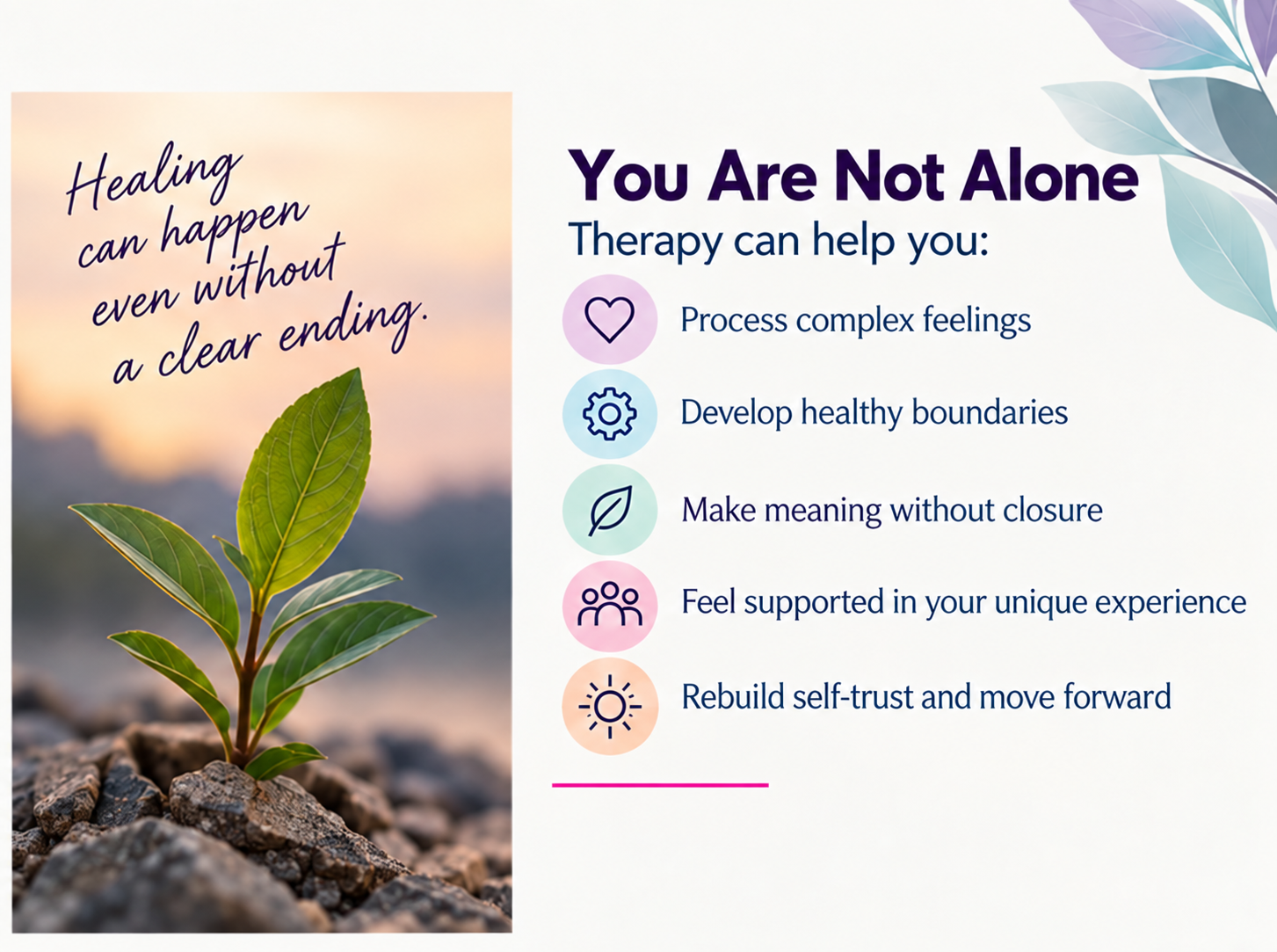
Therapy may help you:
Identify and name the losses you are carrying
Process grief that others have minimized
Work through guilt, anger, sadness, or relief
Develop boundaries
Reduce repetitive “what if” thinking
Explore family roles and relationship patterns
Build tolerance for uncertainty
Create meaning even without closure
Adjust to changing relationships
Reconnect with your own values and needs
Research on ambiguous loss suggests that meaning-making can be particularly difficult when a loss remains unclear. Therapy can help people develop a more coherent and self-compassionate understanding of what they have experienced.
The goal is not necessarily to stop caring.
The goal is to help uncertainty take up less of your life.
You Do Not Need Closure to Begin Healing
Some relationships end with a goodbye.
Others fade, change, fracture, or disappear without explanation.
Sometimes the person remains physically present while the relationship slowly changes around you.
There may never be a perfect ending.
There may never be an answer that makes everything feel complete.
But healing does not require every question to be answered.
You can grieve what changed.
You can honor what mattered.
You can set boundaries around what hurts.
You can create meaning from what remains.
And you can continue building a life even while part of you still carries love, questions, memories, or hope.
At Prism Psychotherapy, we support people navigating grief, complicated family relationships, trauma, caregiving, estrangement, identity changes, and major life transitions.
If you are grieving someone who is somehow both here and gone, your grief is real.
You do not have to wait for a traditional ending before allowing yourself to heal.
Sources
The concept of ambiguous loss was developed by family therapist and researcher Pauline Boss, who began studying unclear loss in the 1970s. Her framework distinguishes situations involving physical absence with psychological presence from those involving physical presence with psychological absence.
Research on families affected by Alzheimer's disease and related dementias describes ambiguous loss as a major source of distress and identifies losses involving identity, roles, autonomy, relationships, and expected futures. A meta-synthesis of 72 studies across 17 countries also identified family support, self-care, communication, meaning, and acceptance among resilience-related processes.
Ambiguous loss research challenges the idea that every grief experience should end in “closure.” Boss and colleagues have argued that when loss inherently lacks finality, a more appropriate therapeutic goal may be developing meaning and greater tolerance for uncertainty.
Research comparing ambiguous and definite losses found that ambiguous loss can make meaning-making and constructing a coherent narrative about the loss more difficult.
Ambiguity can also occur after relationship disruption. Research on unclear marital separations found themes including loneliness, uncertainty, and difficulty knowing how the relationship will ultimately end, while recent research on later-life divorce discusses the boundary ambiguity that can follow changes in family structure.
Recent 2026 research involving families of people in a permanent vegetative state similarly describes ambiguous loss as the coexistence of presence and absence and emphasizes the role of meaning-making and maintaining relational bonds.
