

When most people hear the word grief, they think of death.
But grief is bigger than bereavement.
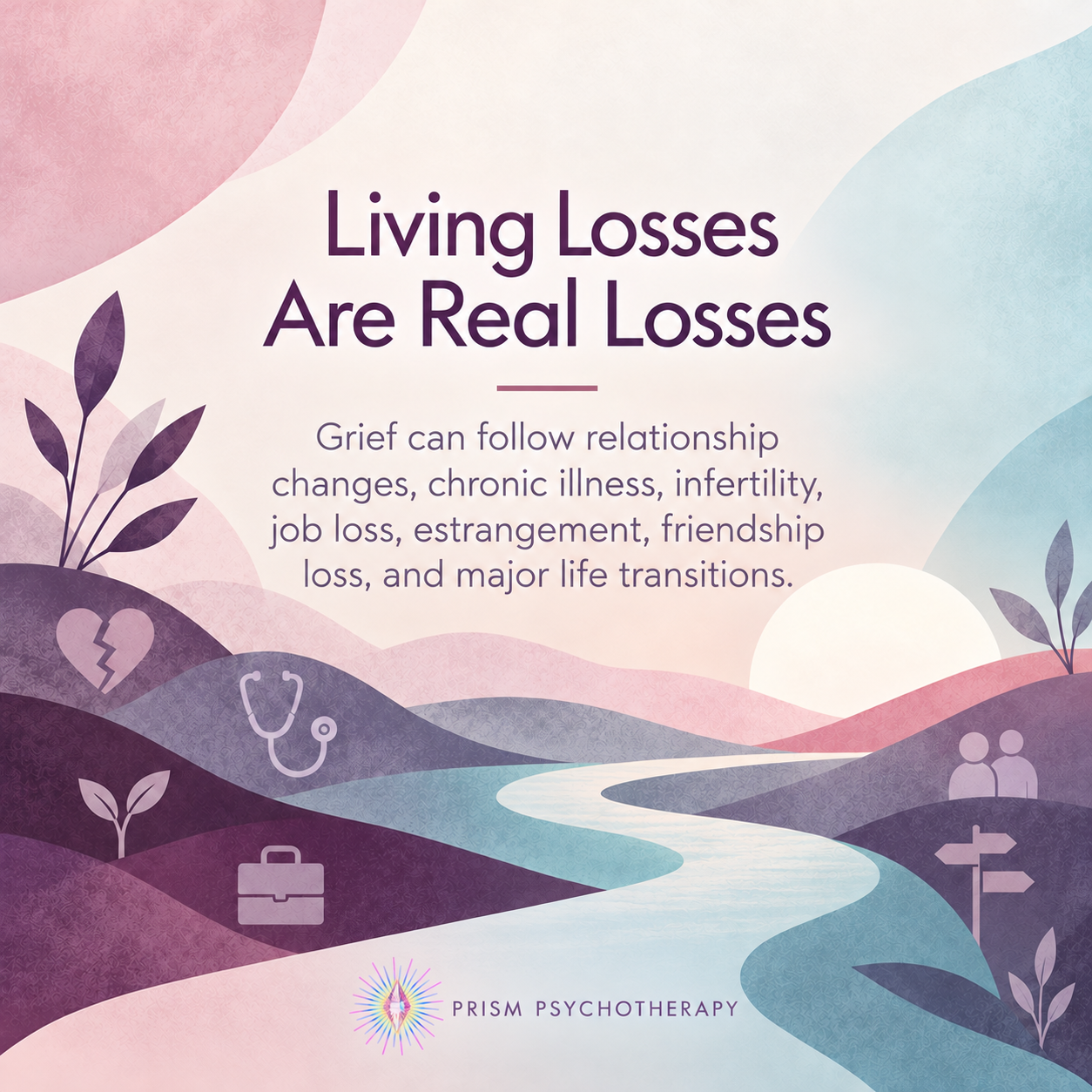
Loss can involve the death of someone we love, but it can also come from a relationship ending, a change in health, the loss of a job, a shift in identity, or the realization that the future we imagined may no longer be possible.
Grief is a response to loss, and that response can affect us emotionally, physically, relationally, and spiritually.
Sometimes the hardest grief to recognize is the kind that happens while life keeps moving around us.
What Are “Living Losses”?
Some losses happen without a death.
Sometimes these losses are described as living losses. They may be chronic, ongoing, uncertain, or difficult to define.
Examples may include:
A serious or chronic illness
The end of a romantic relationship
Job loss
Mental illness
Substance use within a family
Incarceration
Major changes in physical ability or independence
The loss may be obvious to you while remaining almost invisible to everyone else.
And that can make grieving even harder.
Sometimes We Grieve What Was Supposed to Happen
Loss doesn’t only affect what we have.
It can affect the life we thought we would have.
A health diagnosis might change your career plans.
A divorce might mean grieving the family structure you imagined.
Infertility may involve grieving hoped-for experiences of parenthood.
An injury may change the way you see your body, independence, career, hobbies, or future.
A relationship with a parent may remain intact on paper while the emotional relationship you needed never truly existed.
These experiences can create losses involving our roles, beliefs, hopes, and dreams.
Sometimes the question underneath grief becomes:
Who am I now?
Loss can disrupt the story we have built about ourselves and the direction our lives were supposed to take.
Why Living Loss Can Feel So Confusing
Living loss often lacks the rituals and recognition that accompany a death.
There may be no funeral.
No sympathy cards.
No designated period during which people expect you to struggle.
Sometimes there is not even agreement that a meaningful loss occurred.
The experience may include uncertainty, the strange feeling of something being both present and absent, minimization from others, disagreement about what the loss means, and complicated questions about whether things might change in the future.
That ambiguity can leave people wondering whether they are even “allowed” to grieve.
They are.
When Other People Don’t Understand Your Grief
Some grief is disenfranchised—meaning the loss is not openly acknowledged, socially recognized, or adequately supported.
The loss may be misunderstood, minimized, stigmatized, or invalidated.
You may hear things like:
“Just move on.”
“At least you still have…”
“You weren’t married.”
“You can find another job.”
“They’re still alive.”
“You should be grateful.”
Sometimes people say these things because they are uncomfortable with pain and desperately want to make it better.
But grief does not disappear because someone finds a silver lining.
And suffering does not become less real because someone else has experienced something different.
Grief Is Not Something We Need to “Fix”
Contemporary grief approaches increasingly recognize that grieving is not simply a problem to solve.
Meaning-oriented grief work emphasizes understanding what a loss means within the unique context of a person’s life.
That can mean exploring questions such as:
What changed when this happened?
What did I lose besides the obvious loss?
What part of my identity was connected to it?
What did I believe my future would look like?
What relationships changed afterward?
What still matters to me now?
There may not be a quick answer.
That is okay.
There is also no universal timeline for grief. People can carry aspects of grief throughout their lives, and no single trajectory is “correct.”
Healing Does Not Require Pretending the Loss Didn’t Matter
Healing may eventually involve rebuilding meaning, connection, identity, and purpose.
But moving forward does not require erasing what happened.
You can build a meaningful life while still acknowledging that something important was lost.
Those two truths can exist together.
If you are struggling with a loss that other people do not seem to understand, therapy can offer a place where you do not have to justify why it hurts.
At Prism Psychotherapy, we believe your experience deserves curiosity, compassion, and space—not judgment and not a demand that you “get over it.”
